


Hey there! As a supplier of counterbalance stackers, I often get asked about the load capacity at different lift heights. It's a crucial aspect that can significantly impact the efficiency and safety of your material handling operations. So, let's dive right in and explore this topic in detail.
First off, let's understand what a counterbalance stacker is. A counterbalance stacker is a type of forklift that uses a counterweight at the rear to balance the load at the front. It's designed to lift and stack pallets in warehouses, distribution centers, and other industrial settings. These machines come in various sizes and configurations, each with its own load capacity and lift height capabilities.
Now, let's talk about load capacity. The load capacity of a counterbalance stacker refers to the maximum weight it can safely lift and carry. This capacity is typically measured in tons and is determined by several factors, including the design of the stacker, the strength of its components, and the stability of the machine.
One of the key factors that affects load capacity is the lift height. As the lift height increases, the load capacity of the stacker generally decreases. This is because the higher the load is lifted, the more unstable the stacker becomes. To maintain stability, the stacker needs to reduce the amount of weight it can carry.
Let's take a look at an example. Suppose you have a 2 Ton CounterBalance forklift. At a lower lift height, say around 1 - 2 meters, it might be able to lift the full 2 - ton load without any issues. However, as you start to increase the lift height to, let's say 4 - 5 meters, the load capacity might drop to 1.5 tons or even less. This reduction in load capacity is a safety measure to prevent the stacker from tipping over.
Another example is the 3 Ton CounterBalance forklift. Similar to the 2 - ton model, its load capacity will also decrease as the lift height goes up. At a moderate lift height of 3 meters, it can handle close to its full 3 - ton capacity. But when you reach a higher lift height of 6 meters or more, the load capacity could be reduced to around 2 tons.
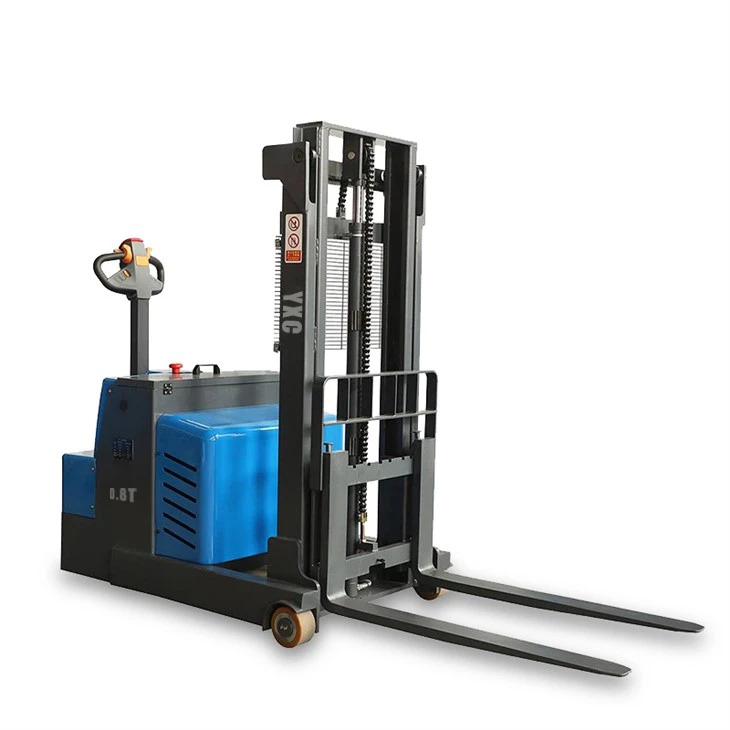
The Walkie Counterbalanced Stacker is a popular choice for smaller warehouses and lighter loads. These stackers usually have a lower maximum load capacity compared to larger forklifts, often in the range of 1 - 1.5 tons. And just like the other models, their load capacity will also be affected by the lift height. At a low lift height of 1 - 1.5 meters, they can handle their full rated load. But as the lift height increases to 3 - 4 meters, the load capacity might be reduced by 20 - 30%.
There are a few reasons why lift height impacts load capacity so much. Firstly, when the load is lifted higher, the center of gravity of the stacker - load system shifts upwards. This makes the stacker more top - heavy and less stable. To counteract this instability, the stacker has to limit the amount of weight it can carry.
Secondly, the structural integrity of the mast, which is the part of the stacker that raises and lowers the load, also plays a role. As the lift height increases, the mast has to support the load over a greater distance. This puts more stress on the mast, and to prevent it from bending or breaking, the load capacity has to be reduced.
So, how do you choose the right counterbalance stacker for your needs? Well, you need to consider your typical load weights and the maximum lift height you'll need. If you have heavy loads but only need to lift them to a moderate height, a higher - capacity stacker like the 3 - ton model might be a good choice. On the other hand, if you have lighter loads and need to lift them to various heights in a smaller space, a walkie counterbalanced stacker could be more suitable.
It's also important to note that load capacity isn't the only factor to consider. You should also think about the maneuverability of the stacker, its battery life (if it's an electric model), and the ease of maintenance.
In addition to the lift height, other factors can also affect the load capacity of a counterbalance stacker. The type of load itself is one such factor. If the load is unevenly distributed or has an irregular shape, it can reduce the effective load capacity. For example, a long and thin pallet might be more difficult to balance than a square, evenly - loaded one.

The surface on which the stacker operates also matters. If the floor is uneven, slippery, or has a slope, it can affect the stability of the stacker and thus its load - carrying ability. A stacker that can handle a certain load on a flat, smooth surface might not be able to carry the same load on a rough or sloped floor.
The speed at which the stacker is moving can also have an impact. If the stacker is moving too fast while carrying a load, especially at a high lift height, it can increase the risk of tipping over. So, operators need to be trained to move at a safe speed based on the load and lift height.
When it comes to ensuring the safe and efficient operation of your counterbalance stacker, proper training for operators is essential. Operators should be aware of the load capacity limitations at different lift heights and should always follow the manufacturer's guidelines. They should also conduct pre - operation checks to ensure that the stacker is in good working condition.
If you're in the market for a counterbalance stacker, I'd be more than happy to help you find the right one for your business. Whether you need a 2 Ton CounterBalance forklift, a 3 Ton CounterBalance forklift, or a Walkie Counterbalanced Stacker, we have a wide range of options to meet your specific requirements.
Contact us today to discuss your needs and start the procurement process. We can provide you with detailed information about our products, including their load capacity at different lift heights, and help you make an informed decision.
References
- Forklift Operator's Manuals (various manufacturers)
- Industrial Material Handling Industry Reports