


Hey there! As a supplier of Robots for Logistics, I've been getting a lot of questions about how our logistics robots handle the identification of different product types. Well, I'm here to break it down for you in a way that's easy to understand.

First off, let's talk about why product identification is so important in logistics. In a warehouse or distribution center, there are countless products of various shapes, sizes, and materials. If our robots can't tell one product from another, it can lead to all sorts of problems. For example, they might mix up inventory, deliver the wrong items to customers, or even damage products during handling. So, accurate product identification is crucial for the smooth and efficient operation of any logistics system.
Now, let's dive into the different methods our logistics robots use to identify products. One of the most common techniques is barcode scanning. Just like at the grocery store, many products in the logistics industry are labeled with barcodes. These barcodes contain information about the product, such as its name, size, and SKU (stock keeping unit). Our robots are equipped with barcode scanners that can quickly and accurately read these barcodes as they move around the warehouse. Once the barcode is scanned, the robot's onboard computer can access a database to retrieve all the relevant information about the product. This allows the robot to handle the product appropriately, whether it's storing it on a shelf, picking it for an order, or transporting it to another location.
But what about products that don't have barcodes? That's where other identification methods come in. One such method is RFID (radio-frequency identification). RFID tags are small electronic devices that can be attached to products. These tags emit a unique radio signal that can be detected by RFID readers. Our robots are equipped with RFID readers that can pick up these signals and identify the products. RFID technology has several advantages over barcode scanning. For one, it doesn't require a direct line of sight between the reader and the tag. This means that the robot can identify products even if they're hidden or stacked on top of each other. Additionally, RFID tags can store more information than barcodes, which can be useful for tracking products throughout the supply chain.
Another method our robots use to identify products is computer vision. Computer vision technology allows the robot to "see" its surroundings using cameras or sensors. Our robots are equipped with high-resolution cameras that can capture images of products. These images are then analyzed by the robot's onboard computer using advanced algorithms. The computer can identify the product based on its shape, color, texture, and other visual features. Computer vision is particularly useful for identifying products that don't have barcodes or RFID tags, or for products that are difficult to distinguish using other methods. For example, our robots can use computer vision to identify different types of fruits and vegetables based on their appearance.
In addition to these methods, our robots can also use a combination of sensors to identify products. For example, they might use weight sensors to determine the weight of a product, or proximity sensors to detect the distance between the robot and the product. By combining the data from these sensors with the information from barcode scanning, RFID, and computer vision, our robots can achieve a high level of accuracy in product identification.
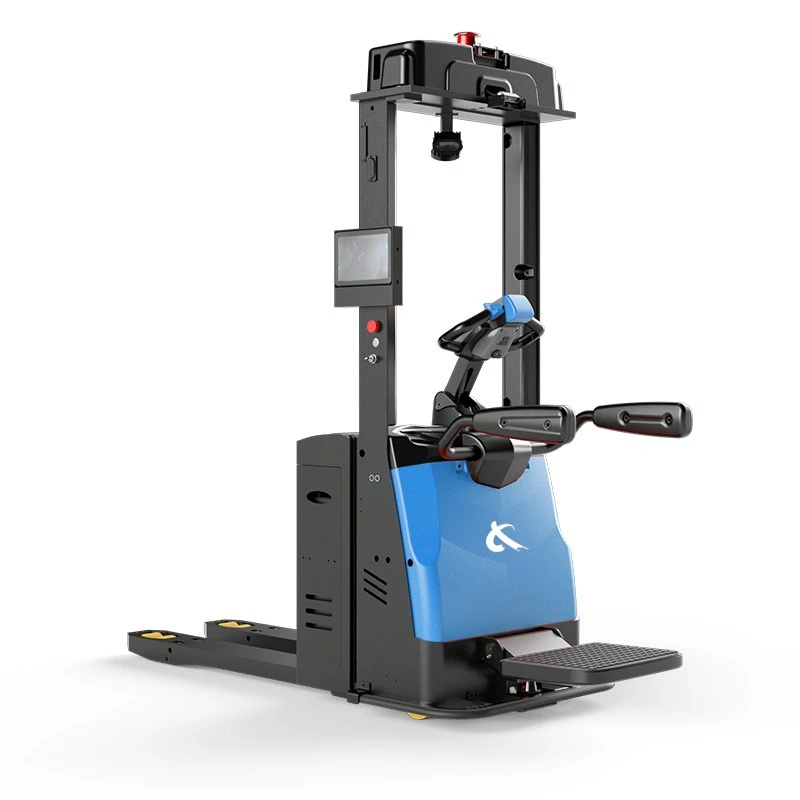
Now, let's talk about some of the specific robots we offer that are designed for product identification. One of our most popular models is the Walk-behind Automated Transport Vehicle. This robot is designed to transport products around the warehouse. It's equipped with barcode scanners, RFID readers, and cameras, which allow it to identify products as it moves. The robot can also be programmed to follow a specific route, which makes it ideal for use in large warehouses.
Another model we offer is the Multi-scenario Intelligent Robot. This robot is designed to handle a variety of tasks, including product identification, picking, and packing. It's equipped with advanced sensors and algorithms that allow it to adapt to different environments and product types. The robot can also be integrated with other systems, such as warehouse management systems (WMS), to provide a seamless logistics solution.
Finally, we offer the High Speed Automated Transport Vehicle. This robot is designed for high-speed transportation of products. It's equipped with the latest technology, including high-speed barcode scanners and RFID readers, which allow it to identify products quickly and accurately. The robot can also operate at high speeds, which makes it ideal for use in fast-paced logistics environments.
In conclusion, our logistics robots use a variety of methods to handle the identification of different product types. From barcode scanning and RFID to computer vision and sensor technology, our robots are equipped with the latest tools and algorithms to ensure accurate and efficient product identification. Whether you're looking for a robot to transport products around the warehouse, pick and pack orders, or handle other logistics tasks, we have a solution that's right for you.
If you're interested in learning more about our Robots for Logistics or would like to discuss your specific needs, please don't hesitate to get in touch. We'd be happy to answer any questions you have and help you find the perfect solution for your business.
References
- "Barcode Scanning Technology in Logistics." Logistics Management Journal, Vol. 20, Issue 3, 2022.
- "RFID in Supply Chain Management." International Journal of Supply Chain Management, Vol. 15, Issue 2, 2021.
- "Computer Vision for Logistics Automation." Robotics and Automation Magazine, Vol. 25, Issue 4, 2023.